
Adaptive Textile Facade – Climate-Responsive Elastic Envelope System
Project Period: Winter Semester 2010/2011
Location: Technical University of Munich (TUM), Germany
Designer: Jie Tang (Design & Development)
Reviwer: Prof. Tina Wolf, Chair of Building Technology and Design, TUM
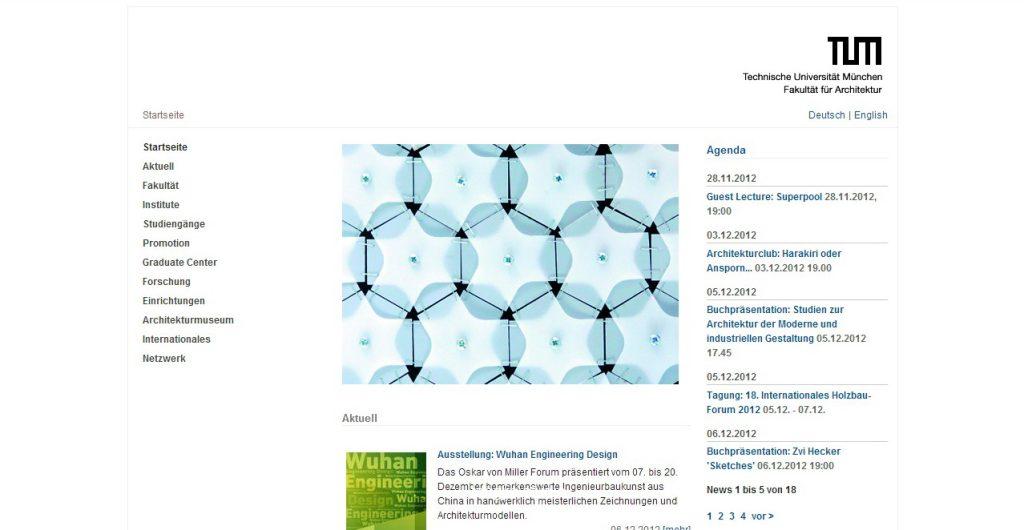
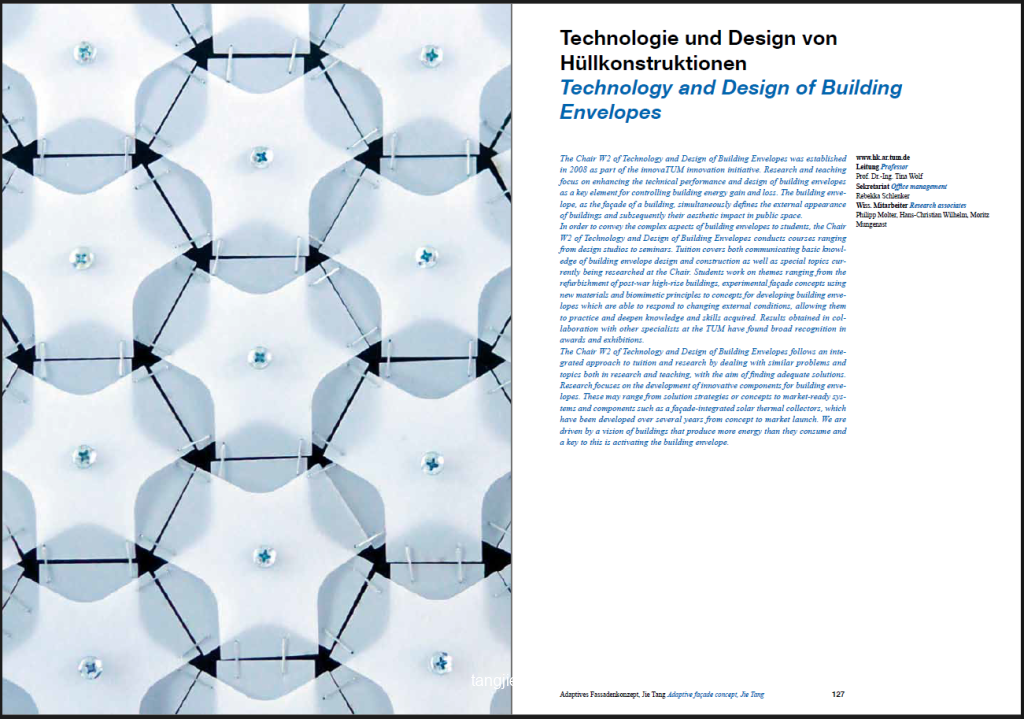
This project explores an adaptive façade system made entirely from elastic textiles, capable of responding spontaneously to environmental influences. Inspired by BMW’s GINA concept car—whose flexible textile skin stretches over a movable substructure—the design investigates how architectural envelopes can behave like a dynamic, climate-responsive membrane.
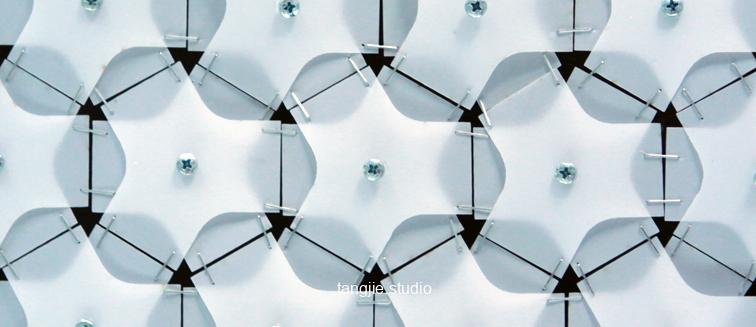
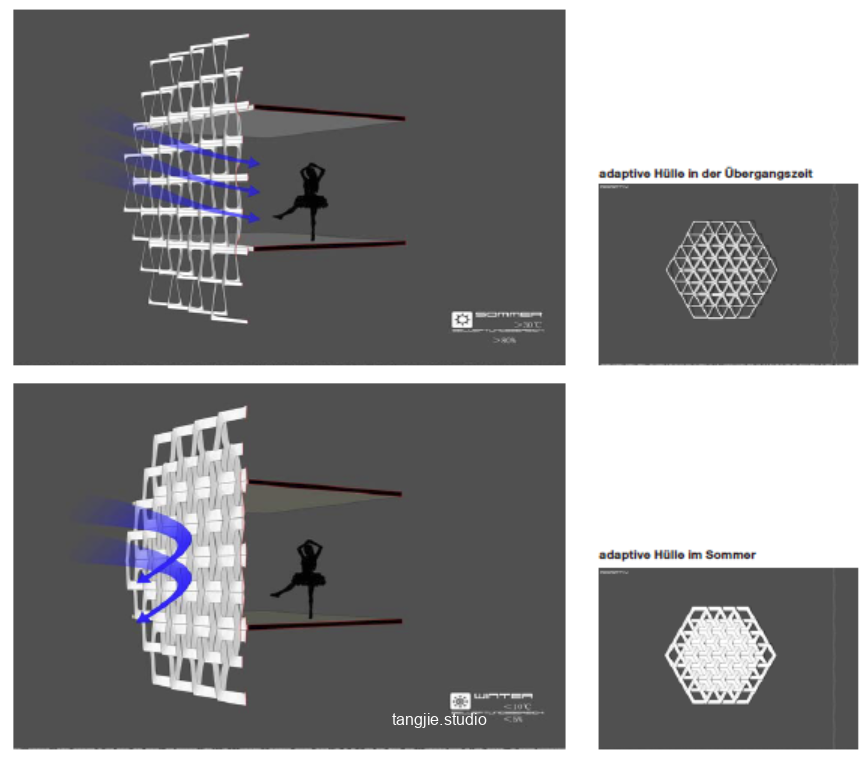
The façade is supported by a three-layer movable spatial framework, whose geometry changes through the length variation of compression rods. Unlike the GINA concept, no additional textile skin is applied; instead, the load-bearing structure itself is made from elastic textiles. When the compression rods extend, the textile layers are tensioned and become thinner and more permeable, allowing natural ventilation and increased airflow. When the rods contract, the façade closes, reducing permeability and improving thermal comfort.
The rods are made of bimetal, enabling temperature-dependent shape change. As a result, the façade can open and close automatically without external energy input, behaving similarly to biological skins that adapt to their environment. This passive mechanism allows the envelope to modulate sunlight, ventilation, and comfort across seasons—reducing glare in summer or retaining warmth in winter.
This work represents an early investigation into adaptive building skins, demonstrating how material behavior, structural transformation, and environmental responsiveness can merge into an integrated architectural strategy.
自适应织物立面 —— 气候响应型弹性建筑围护系统
项目时间: 2010/2011 冬季学期
项目地点: 德国 慕尼黑工业大学(TUM)
设计者:唐杰
指导:Tina Wolf教授,TUM 建筑技术与设计教研组
本项目研究一种由弹性纺织材料构成的自适应建筑立面系统,能够根据环境影响进行即时响应。其核心概念源自 BMW 的 GINA 概念车——通过可变形的支撑结构,让柔性纺织外皮实现动态形变。本项目将这一思想引入建筑领域,探索建筑围护结构如**“动态膜”般的气候响应能力**。
立面的支撑体系由三层可变形空间框架构成,通过调节压杆长度改变整体几何形态。与 GINA 不同的是,本项目不再使用额外的纺织外皮,而是直接让具有弹性的纺织材料作为结构本体。当压杆伸长时,纺织层被拉紧,结构变得更薄、更透气,使更多自然风进入室内,实现被动通风与自然调节;当压杆缩短时,立面关闭,达到减少空气渗透、提升热舒适性的效果。
压杆采用双金属材料(bimetal),可随温度变化自行伸缩。因此整个立面系统能够无需外部能源,自动实现开合,如同生物皮肤一般适应外界环境。在冬夏季节中,立面能够自主响应太阳直射、通风需求等环境变化,实现遮阳、保温与空气流动的动态调节。
该项目代表了对 建筑自适应外皮(Adaptive Building Skin) 的早期探索,将材料特性、结构变形以及环境响应机制整合为统一的建筑策略,展示了未来适应性建筑可能的发展方向。